SiliconANGLE article by Jason English
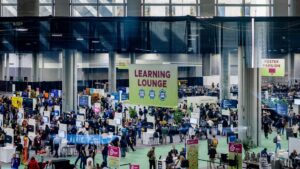 As you would expect this year, some of the conversation at this week KubeCon/CloudNativeCon North America 2025 in Atlanta felt a little bit like a support group. We’re all trying to get past the hype, and come to grips with the risks and opportunities artificial intelligence presents for the cloud native development community.
However, there’s also a positive undercurrent of platform engineering revival going on here, since we can assume most developers and operators are already using some AI-enabled tooling in order to deliver some form of AI-powered application functions.
What are the new ideal practices for equipping cloud native developers with everything they need to build with AI on scalable and resilient infrastructures, including Kubernetes and all of its surrounding ecosystem of both mature and emerging projects and vendors?
“Cloud native and AI-native development are merging, and it’s really an incredible place we’re in right now,” Chris Aniszczyk, chief technology officer of the hosting Cloud Native Computing Foundation, said in the opening keynote. “How do we take all the capabilities Kubernetes provides like autoscaling, and apply that to AI training, and inference, and agents to take it even further?”
Of particular note at this event was the launch of CNCF’s Certified Kubernetes AI Conformance Program, which sets open standards for making AI workloads predictably deployable on Kubernetes so they can be interoperable and portable across different infrastructure types.
To get our arms around consumption and cost concerns, new Dynamic Resource Allocation capabilities optimize the performance of AI workload deployments across graphics processing units, tensor processing units and other hardware, including mainframes. Yes, AI is finally becoming a responsible cloud-native citizen.
Platforms will change, but the practice of platform engineering grows
At my first KubeCon in 2018 in Seattle, I marveled at the dozens of emerging tools forming around the Kubernetes project. By now, all of those projects should have graduated, or perhaps gotten archived. Such simpler times compared to today’s dizzying CNCF Landscape eye chart of hundreds of projects.
January 2025’s “DeepSeek Moment” was really just a blip in computing history, but when Chinese researchers produced a solid open-source large langauge model, it became clear that despite infinite capital investment in commercial AI solutions, there will never be one perfect model to rule them all. The open source community can and will build comparable platforms for generative AI and agentic AI development.
“I think it’s a sign of maturity that even when you mix in cloud native development with the current AI hype, organizations are actually realizing that developers are still the internal customers who need platforms as products. You can’t just say ‘get on with it’ and hand them a box of tools,” said Daniel Bryant, head of marketing, Syntasso Ltd., who was distributing a handy little O’Reilly guide to platform productization at the show.
Pavlo Baron, co-founder and chief executive of Platform Engineering Labs, said that on day one, when developers are writing code and making changes, they’re at an abstract level…
Read the entire event roundup article on SiliconANGLE here: https://siliconangle.com/2025/11/15/ai-leads-platform-engineering-revival-kubecon-na-2025/
Click here to read this article in Chinese.
Jason English is a principal analyst and chief marketing officer at Intellyx. He wrote this article for SiliconANGLE. At the time of writing, none of the companies mentioned here are Intellyx customers. No AI was used to generate this content. CNCF covered the analyst’s attendance cost for the event, a standard industry practice. ©2025 Intellyx B.V. Photo: CNCF
Organizations mentioned here: AuthZed, Cloudsmith, ControlTheory, CNCF, Edera, Flox, Golem, Komodor, Kusari, Syntasso, Testkube, Tigera.