Intellyx Cortex Newsletter by Eric Newcomer, Principal Analyst
Application modernization is a top priority for many organizations, and the market is growing at 15% a year. Much of the demand is driven by the need to ensure systems are AI-enabled.
Gartner released the AI Augmented Code Modernization Magic Quadrant August 3, which shows Microsoft, AWS, and Moderne as the leaders, with Rocket Software and BMC as the challengers. IBM, Cursor, and Anthropic are the visionaries, and EvolveWare the niche player.
In their post about appearing as a leader in the quadrant, Microsoft says that AI coding reduces the time and cost of modernization, eliminating the major barrier. This is an important factor and definitely something AI can help with.
But modernization cannot be about AI automation alone. It has to be about why you would modernize an application, the business value of doing so, how you would define the strategic target architecture, and how to document the current state.
The trickiest part for AI has to be defining the target architecture. Although many have tried, it isn’t possible to incrementally infer or generate a target architecture from a current state, and the current state is pretty much all AI has to go on.
Business and technology changes too fast. Someone has to look toward the future and figure out what it will look like. Without this, modernization is only a cost saver, and its true value goes unrealized.
In fact the argument that you need to modernize to ensure systems are AI enabled is a perfect example of the fallacy that AI assistance is all you need to succeed.
No one really knows what it means to ensure your systems are AI enabled, because no one is really sure about the role AI plays in all applications. At this point everyone is basically guessing and changing course as quickly as possible as the technology evolves and people figure out what it’s really good for.
Natural vs Managed Evolution
At Credit Suisse we had an architecture program called “managed evolution,” which called for inserting abstract interfaces between an application and its UI and other integration points.
Once access to an application was abstracted, we could update and evolve the technology stack to move it or pieces off the mainframe, for example, or to modern languages and products, without disturbing application users. This could be very useful for AI, but of course someone has to do the design work.
The opposite of managed evolution, of course, is natural evolution, which inevitably produces a “big ball of mud,” just as the lack of building codes produces a shanty town without running water or a sewage system. And if you leave the design work up to AI it’s very likely this is what you’ll get.
One of the major motivations for modernization is to migrate to supported or secure versions of vendor products. But a software upgrade by itself wasn’t always easy to justify, since very often a new software product version did not include any new features we needed. Often we had to wait for the budget to be approved for a strategic change (i.e. business value change) to tie the software upgrade to.
Microsoft’s argument makes more sense for this purpose, but of course what they want is for you to migrate to new versions of Microsoft technology.
(As a side note this is a fundamental conflict between software vendors and their customers, since a vendor’s business model depends on selling new versions of software products while businesses using older versions typically do not have any clear requirement for features in the new versions. Nobody really needs a new feature in Word, for example.)
A better motivation for modernization is to improve the strategic business value of an application – in other words, add features and capabilities that either drive additional revenue or increase cost efficiency. The ROI of modernization becomes clearer and stronger. (Managed evolution also helps here since it’s easier to introduce new capabilities into a coherent architecture.)
An overlooked consideration is often that organizations don’t really want “bug for bug” compatibility with existing applications. They want modern versions of applications to meet new requirements, and to eliminate capabilities they no longer need.
Forget about the Current Application
As good as AI tools are at source code understanding and rewriting or generating code, they are not very good at enterprise architecture. They do not work at the big picture level. Someone has to define an architecture framework for the AI tools, and tell them how to break up the problem into modules they can assemble.
A major challenge of modernization then becomes how best to design the target state of the new application to achieve maximum ROI.
At Citi I would encourage business and technology application owners to completely forget about the current version of an application, and instead think about what it should look like in 3-5 years as a target (and by the way it’s not an “end” state because it’s always moving).
First, they had to figure out what their business would look like in 3-5 years, taking into account technology, business, and market trends. This was often the most challenging part because it was hard to get agreement.
The idea was to figure out what business services they wanted to offer to increase business or retain customers, and if they could do that, we could pretty easily define the matching software services, map those to the current state, and identify the gaps we needed to close.
We used service oriented architecture because it more easily and naturally maps to the services an enterprise offers its customers. Using the simple example of a bank, the tellers offer deposit, withdrawal, transfer, loan payment, and perhaps currency exchange services. Each of these can easily be modeled as a software service by using the name of the function and identifying the data to be submitted for processing, and optionally returned on the reply.
(This is, by the way, in my opinion at least, much easier than trying to define objects with methods, although this will also work.)
Documenting the Current State
Once you have defined the target state for the modernized application, you have to clearly and exhaustively document the current state of the application to understand what to keep, what to change, and what to add.
This is where the AI modernization tools really help. AI is great at summarizing large amounts of information and performing research tasks that otherwise would take humans a long time to complete.
 Gartner offers a longer list of modernization vendors in their reviews and ratings, including Astadia, Blitzy, Cast, COBOL Colleague, Devin, Mechanical Orchard, Model Core, Swimm, and VFunction, among others.
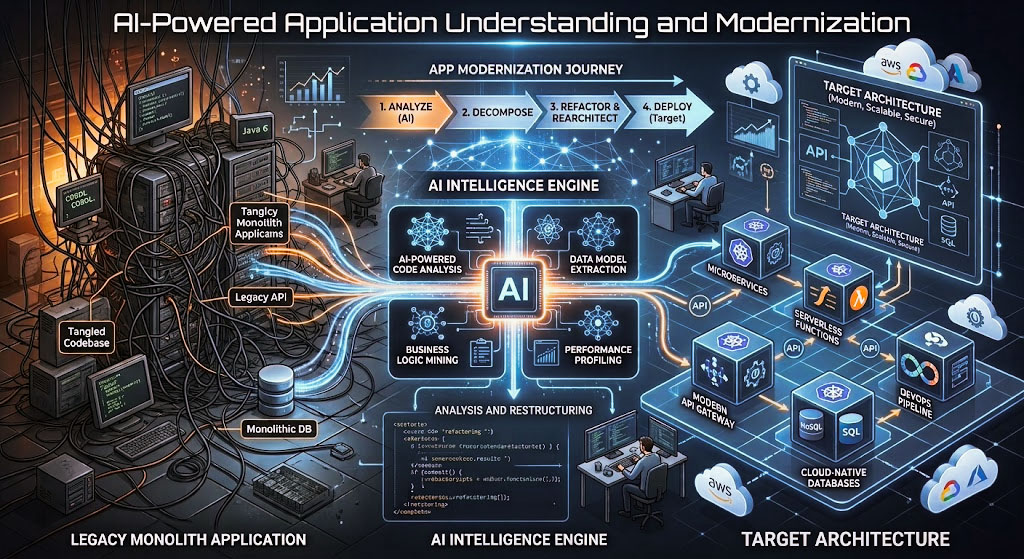
These products are variously aimed at cloud migration, COBOL/mainframe modernization, documentation, microservices refactoring, transcoding, and so on. Mostly they try to solve the problem in a single step, and take an existing application (anything is production is legacy, as someone said) and modernize it in one pass.
Most of the modernization vendors listed by Gartner require you to identify the source and target before you get started. This can work but as I’ve noted this approach will not result in the best ROI since it skips over the 3-5 year strategic target architecture step.
I would like to mention three additional products: Concho, Gallop, and VCola.
Congo and Gallop provide an essential result of source code understanding and analysis that allows customers to produce and work with an intermediate representation of an application, integrating the intermediate representation with a series of AI agents that analyze, work iteratively with humans on the design, and then generate the new application.
An agentic AI system such as VCola consumes that representation as context to define a target state and generate code for that target state.
In other words these products are not tied to a particular input and output pair, and are not trying to automatically convert or transcode an application from one format to another. I think this is the right approach to define and achieve a strategic modernization outcome with an excellent ROI, rather than investing in a project that simply reduces time and cost and produces a like for like (bug for bug) version of the application.
The Intellyx Take
Application modernization has never been so popular. AI is the motivation and the enabler. People want to modernize to take advantage of gen AI capabilities for business benefit – in fact this is becoming a point of competition.
AI coding agents are reducing the time, effort, and expense to nearly zero. In fact you could almost say that the code generation part doesn’t matter, it’s the quality of the requirements, target architecture, and application understanding that does.
Organizations have invested significantly in automating their business processes. And now the knowledge of operating the business is effectively encoded in these applications using computer programming language and it needs to be converted into human language for AI tools.
The world needs a kind of reverse engineering process to undo the process used to create the applications in the first place (i.e. converting human language to computer language).
But the large companies are focused on migrating applications to their platform. Most startups don’t have depth and breadth of expertise in legacy apps.
Foundation models are incomplete because they are not trained on legacy code and don’t understand legacy applications.
The key seems to be producing an intermediate state that humans and agents can work with to figure out and design modernized applications for strategic value. Not simply transcoding or upgrading the tech stack.
Copyright © Intellyx BV. Intellyx is the change agent industry analysis and advisory firm focused on enterprise transformation. Covering every angle of enterprise IT from mainframes to artificial intelligence, our broad focus across technologies empowers business executives, IT professionals, and software vendors to leverage disruptive trends to succeed in a dynamic business environment. This article was written by a human. BMC, Concho, and Rocket Software are Intellyx customers. IBM and VFunction are former Intellyx customers. Eric Newcomer is an advisor to Concho.ai. Images by Google Gemini.