
Intellyx Brain Blog for Verge.IO By Eric Newcomer
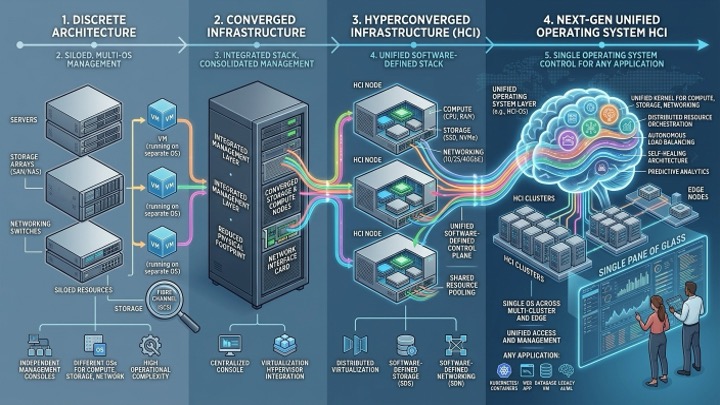
Infrastructure convergence is constantly trending toward improved abstraction, operation, and control. Similar to the way a traditional operating system abstracts, controls, allocates, and monitors compute, storage, and network resources for monolithic applications, converged infrastructure operating systems are emerging to meet the same requirements for highly distributed, cloud native applications.
Cloud Native Infrastructure Ten Years Ago
When I was leading cloud migration for Citigroup’s institutional bank about ten years ago, our goal was to achieve elastic capacity for our payment processing systems, which were always stretched to the max. We also needed to improve the resiliency of those applications to better support global businesses on a daily basis.
The migration effort involved re-engineering the applications but also required using cloud native new infrastructure to achieve the desired benefits.
We estimated compute, disk, and network capacity for the initial deployment, and estimated scaling and resilience resource requirements as well. These were individual calculations, but of course were interdependent and represented in the designs as our total resource requirements.
A lot has changed in the past decade, including the emergence of many new cloud provider services, increases in cloud computing cost, increasing availability of private cloud infrastructure, and new storage and networking options.
Hyperconverged infrastructure reduces a lot of this effort, but it doesn’t unify application access to resources or provide common governance and control.
VergeIO fills this gap with a common abstraction layer called the Private Cloud Operating System (VergeOS), which virtualizes infrastructure resources across the data center.
Instead of using different APIs for different resources, developers use a common operating system that abstracts access to and consumption of distributed resources as if they were running on a monolithic server, which finally meets the unified infrastructure requirement.
Unlike ten years ago, organizations don’t necessarily have to rewrite existing applications to take advantage of cloud-native infrastructure characteristics. Instead they can use VergeOS to provide that abstraction, resiliency, and flexibility.
The Convergence Story
Infrastructure convergence started with the integrated compute/storage/networking stack era. Hyperconvergence combined virtualized compute with software-defined storage across a cluster.
Breaking the hyperconverged infrastructure habit means adopting a unified operating system such as VergeOS that deals with distributed infrastructure resources using a single abstraction layer, just as a traditional operating system does for a single server.
Because cloud native infrastructure is designed to tolerate failure of any kind and continue processing, a traditional operating system that allocates resources for a single server isn’t going to work. Additional controls are needed to manage redundant servers, disks, and network switches.
Now that the benefits of elastic capacity and improved resilience are available for the data center, and given rising public cloud costs, more and more workloads are taking advantage of the private cloud option.
At Citigroup we wanted the elasticity and reliability of cloud native infrastructure but it wasn’t simple to redesign and re-engineer our applications to achieve it. Operating systems at the time offered abstractions for resource allocation in single monolithic servers but were not available across the highly distributed characteristic of cloud native computing.
At the time infrastructure architectures were evolving to sort of meet somewhere in the middle – simplifying the relationship between distributed applications and distributed infrastructure, which had mostly been manual.
However this still did not fundamentally change the relationship between the application and the infrastructure. It made the infrastructure easier to deploy and manage, and perhaps offered some level of price efficiency.
Kicking the hyperconverged infrastructure habit means adopting a unified abstraction to applications through which they access the converged resources.
In fact what was needed was a new type of operating system that manages distributed resources, rather than a system that coordinates across multiple operating systems managing individual server resources, but we never had the option.
The converged operating system is the simplification needed to help applications move to the cloud native processing model more easily, seamlessly, and reliably.
How VergeOS works
Ten years ago, designing and deploying applications for cloud native infrastructure meant manually figuring out how to combine virtualization, containers, storage, networking, orchestration, backup and disaster recovery capabilities using public-cloud services, and engineering the automation that made all of those components work together.
VergeOS approaches the problem from the opposite direction: the infrastructure is already an integrated, programmable platform with the automation built in.
Infrastructure is grouped into Virtual Data Centers, or VDCs, which encapsulate the compute, storage, networking, security, and policies for an application or group of applications.
VDC infrastructure expands as servers are added while compute and storage scale independently.
For disaster recovery, a VDC can be snapshotted, cloned, moved, and replicated as a unit, including its networking and configuration.
The Intellyx take
A decade ago we spent a lot of time figuring out how much compute, networking, and storage resources we needed for our cloud deployments, and how to develop the provisioning and deployment automation scripts and configuration definitions.
This was the case equally for public and private cloud deployments (we actually started with custom built private cloud infrastructure and then moved some of the applications to AWS).
We found ourselves challenged to maintain and upgrade the infrastructure as we grew our cloud footprint, resulting in significant additional work.
VergeOS eliminates much of that work. Instead of assembling private cloud infrastructure components individually, VergeOS provides the abstraction of a cloud native operating system and allocates resources for you the way a traditional monolithic server operating system does.
Copyright © Intellyx BV. VergeIO is an Intellyx customer. Intellyx retains final editorial control of this article. A human wrote every word of this article. Image credit: Google Gemini.




Comments
Comments are closed.